
On 5 November 2026 Anthropic added Personal Finance to Claude: link US bank, card, loan and investment accounts through Plaid, and Claude reads the balances and the last two years of transactions. It is a beta, rolling out this week to Pro, Max and Ultra subscribers in the United States. Finances For AI is a different shape of thing. It is a record your assistant keeps, filled by sentence and by receipt, that works from Claude, from ChatGPT and from any other assistant that supports the Model Context Protocol (MCP), the open standard both assistants use for connectors.
Claude’s strengths first. Every claim here was read from Anthropic’s announcement, its help centre and its pricing page on 5 November 2026, the day of the launch. A beta changes fast; where something could not be confirmed, we say so. Claude is Anthropic’s trademark.
What Personal Finance in Claude does well
The bank feed. You sign in to your bank inside Plaid, Claude never sees the password, and from then on the transactions arrive on their own: amount, date, merchant, category and the bank’s description, up to 24 months back, from up to 16 bank logins. Access is read-only, and Anthropic says plainly that the feature cannot move, manage or invest your money. A Personal Finance hub shows widgets for spending, cash flow, accounts, subscriptions, upcoming bills and short insights, which you can add, edit and reorder. Ask what is left before payday and Claude works it out from the upcoming payments. Ask it to go through the statements and it flags duplicate charges, unexpected fees and bills that have crept up. Conversations in the hub are not used to train Anthropic’s models, are kept out of Claude’s memory, and carry no ads or sponsored suggestions. If what you want is your real accounts, read by Claude without typing a thing, this is now built in.
1. How does your AI reach it?
Personal Finance in Claude: it is a part of Claude. There is nothing to add; a tab appears on the web, desktop, iOS and Android apps once the rollout reaches your account. That is also the whole of where it works. Anthropic’s help centre says linked accounts cannot be used in scheduled tasks, in Cowork or in Claude Code, and it is not in Claude Duet. ChatGPT, or any other assistant, cannot see it at all.
Finances For AI: a remote server you add by address in Claude or in ChatGPT; the add page has the steps. Sign in with a one-time code sent to your email, and one account serves every assistant you add it to. Ask Claude a question in the morning and ChatGPT the same question at night; both read the same record. Finances For AI runs no model of its own and is not tied to any AI provider. If you change assistants next year, the record comes with you.
2. Can the AI write as well as read?
Personal Finance in Claude: it reads. The record is what the bank sends, and it arrives categorised from the bank’s description. Budgets and goals exist as settings on the hub’s widgets, set during setup or after. We could not find a way to add a transaction of your own, so a cash purchase, a split bill or anything from an account you have not linked is not in the picture. Anthropic’s help centre says as much: budgets can overstate what is left when some accounts are not linked.
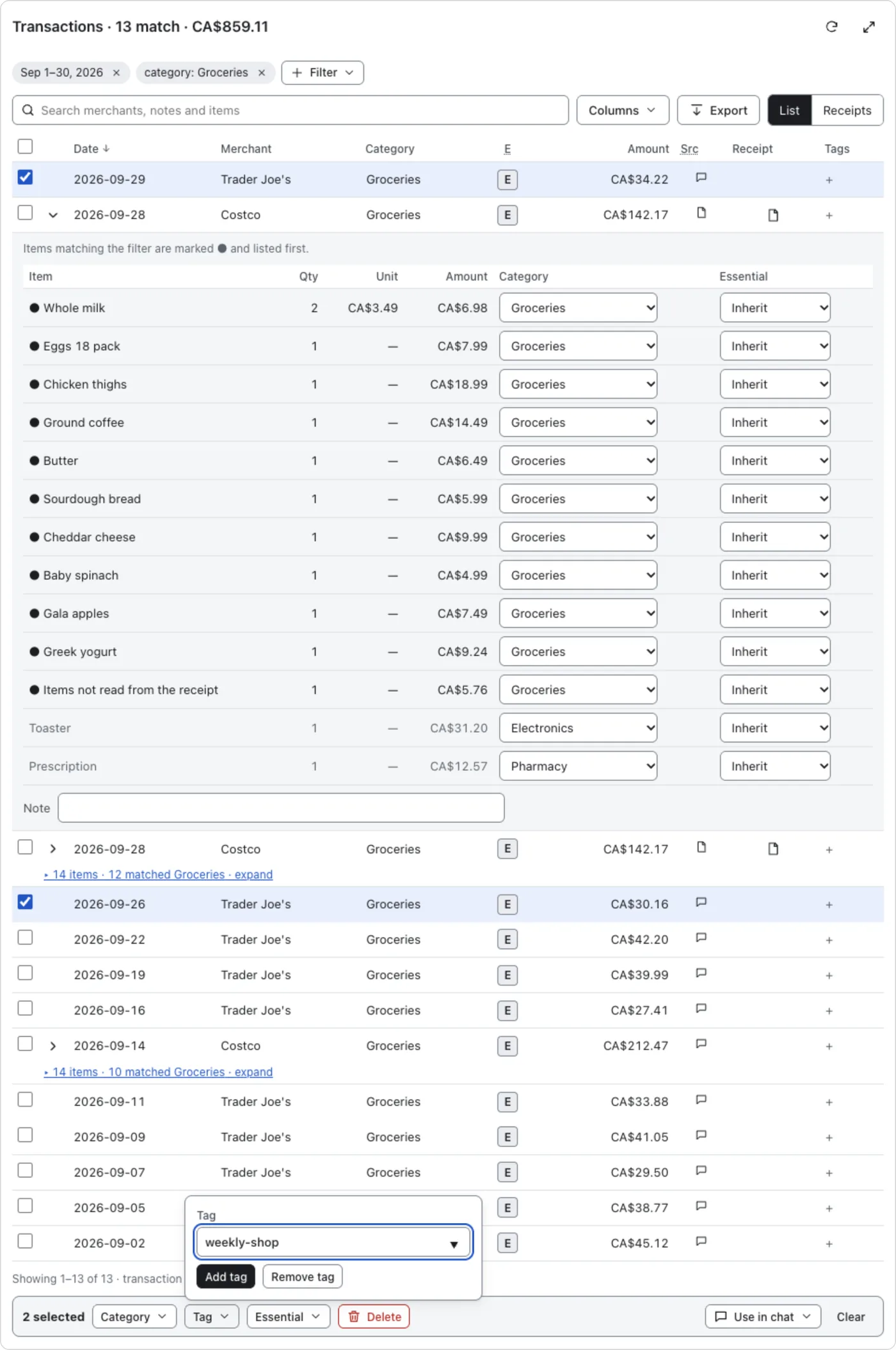
Finances For AI: read and write, on both plans, by saying it. “I spent $42 at Costco” is a purchase. “Set a $500 a month budget for groceries” is a budget, and from then on your assistant tells you when it passes 80% and when it runs out. “Here’s my receipt” with a photo is an itemised transaction after a review screen. Cash, cards, a second currency on holiday: if you can say it or photograph it, it is in the record. Editing happens in the chat too. Select rows on the Transactions screen and change their category or tag together, or tell your assistant to.
3. What do you see in the chat?
Personal Finance in Claude: a real interface, which is more than most connectors offer. The hub is a page of widgets, and in a conversation Claude can build artifacts: a weekly chart, a calendar of due dates, a dashboard you adjust. Figures in those answers can be a day or two behind the bank, and the help centre asks you to check important numbers against your bank.
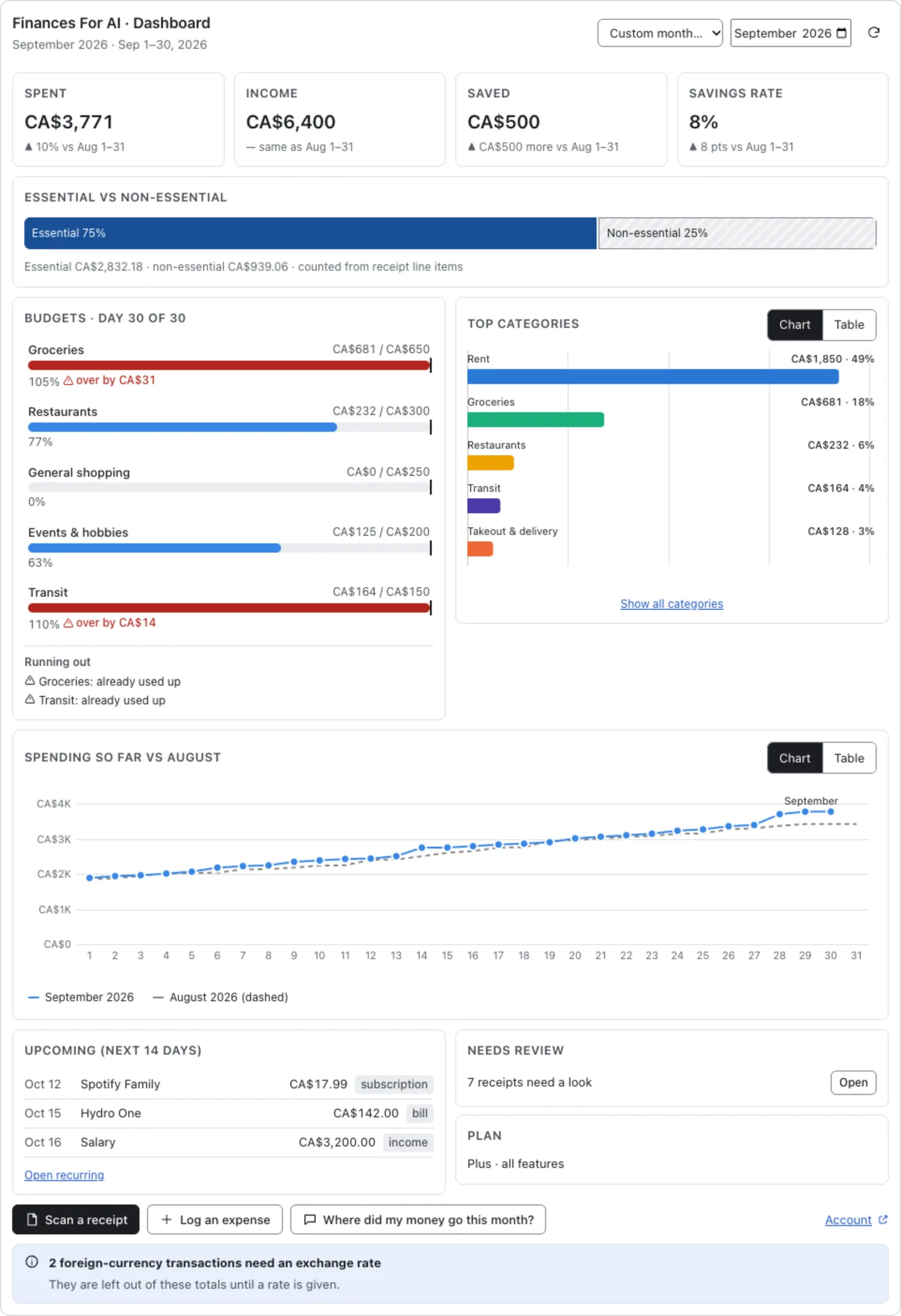
Finances For AI: nine visual, interactive screens, shown inside the chat by AI assistants that support the MCP Apps protocol (including ChatGPT and Claude). Dashboard, Spending Report, Transactions, Receipt Review, Recurring, Net Worth, Goals, Categories and tags, and the Setup Wizard. Each chart has a table view and a drill-down to the transactions behind it. The Dashboard answers “How am I doing this month?” with spent, income, saved and savings rate, every budget as a bar with its share used, and the ones running out. Elsewhere the same answers come as plain text.
4. What does it cost per year, and what does the free tier hold?
Personal Finance in Claude: it comes with a paid plan and is not sold on its own. Anthropic’s help centre says it is not available on Free, Team or Enterprise. As quoted on claude.com/pricing on 5 November 2026, Pro is US$17 a month billed annually, which is US$204 a year, or US$20 month to month; Max is US$100 a month and Ultra US$200. If you already pay for Pro, the feature costs nothing more. If you are on Free, it is a US$204 reason to pay. When a paid plan ends, so does the feature, though the bank links stay until you remove them.
Finances For AI: Free is forever, not a trial. 50 logged transactions a calendar month, every screen and report, 1 GB of receipt files, two active goals, export always. Plus is US$24 a year plus applicable taxes: unlimited transactions, unlimited goals, 20 GB of files, receipts by email, cancel any time, and a 30-day money-back guarantee on the first year’s payment. (Just $2 per month.) The plans page has the detail.
The part that matters for the comparison: Finances For AI is a connector, and Anthropic’s help centre says a Free Claude plan can add one custom connector. A Free ChatGPT account can add one too. So the record works from a free account in either assistant, with no paid plan on either side. You pay Finances For AI for the record only, because the assistant does the reading and there is no bank aggregator to pay.
5. Where does the data live, and what does the AI provider see?
Personal Finance in Claude: the bank data comes through Plaid, under Plaid’s own terms and privacy policy, and the providers that host Claude handle it too. US banks only; outside the United States the feature does not appear. Anthropic says hub conversations are not used for training and are not saved to memory. Bank figures that appear in a chat stay in your chat history until you delete the chat. Unlinking the last bank deletes the widgets, the budgets and the setup answers, and that cannot be undone. On export, the help centre says data exports do not yet include the saved Personal Finance dashboard; inside a finance chat Claude can still show tables and make a CSV file when you ask.
Finances For AI: one database per account, hosted on Cloudflare, encrypted in transit and at rest. It holds what you log and the receipt files you add, unless you turn image storage off. Card and account numbers are removed from what a receipt records. It holds no bank credentials because it does not connect to a bank; that is how it works, and the cost is that nothing syncs. (We’re considering adding bank account sync. If you’d like it, ask your assistant to log the feature request.) Export is CSV, JSON and a ZIP of receipt files, any time, on any plan, even at the Free plan’s monthly limit. Finances For AI never uses your records for training or ads. What the AI provider sees is the conversation, what you type and what the connector returns, under Claude’s or ChatGPT’s own data controls.
The receipt, and the lines under the total
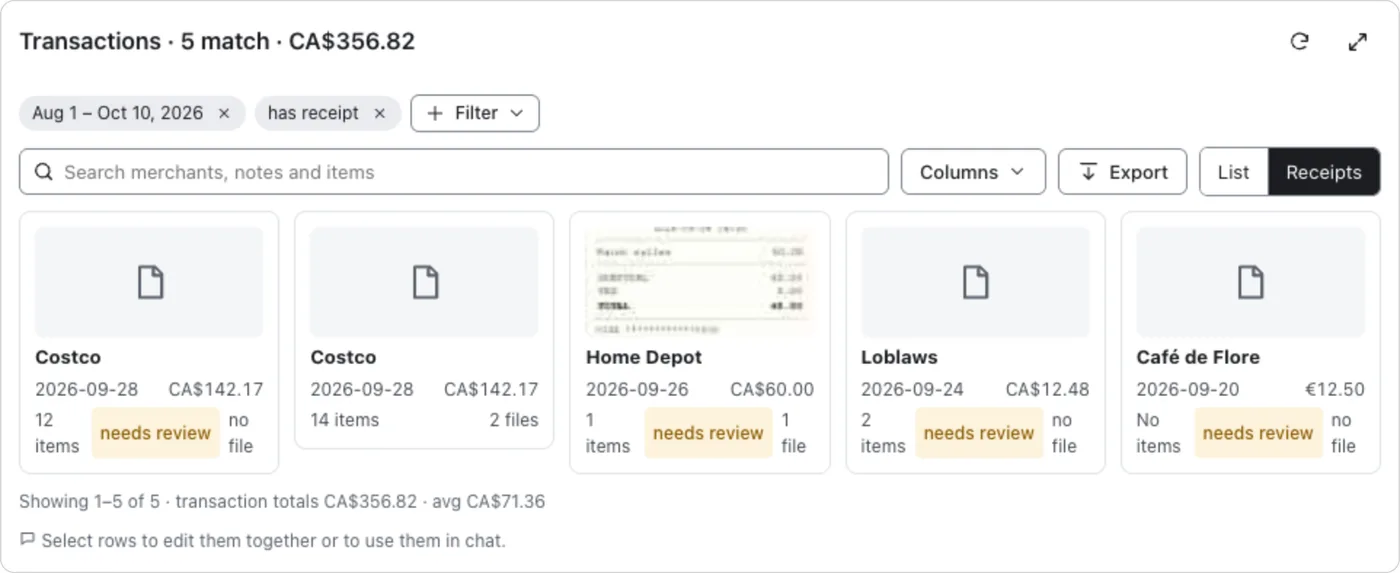
This is the biggest difference in daily use. A bank feed knows that you spent CA$142.17 at Costco. It does not know that part of it was a toaster, part a prescription, and the rest groceries, so every Costco run is “shopping” or “groceries” as one lump. Finances For AI starts from the receipt. Say “Here’s my receipt” with the photo attached. Your assistant reads the merchant, date, items, tax and total. Finances For AI checks the maths, catches duplicates, suggests a category per line and opens the review screen. Each line can be essential or not, and each gets its own category, so “what did I spend on groceries?” counts the groceries and not the toaster.
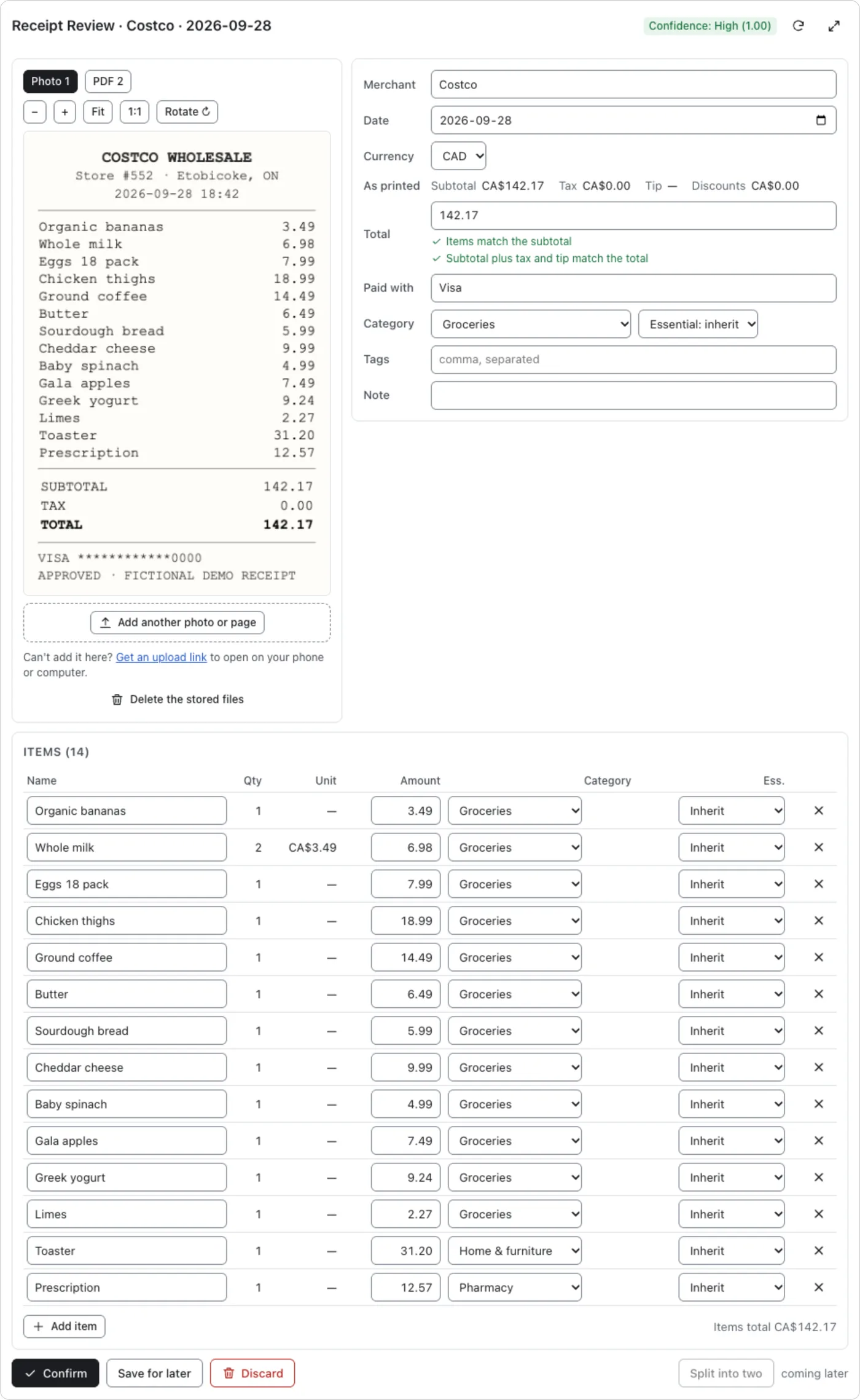
The receipt itself is kept, photo or PDF, all pages, and opens again from the chat whenever you need it: a warranty claim, an expense report, tax time. “Did I buy batteries in March?” has an answer, because the search covers items, not just merchants. A period’s receipts export as a ZIP with a CSV index. We found no mention of receipts, uploads or line items anywhere in Anthropic’s material; the record there is the bank’s transaction, and nothing smaller.
If you ever leave Claude
Personal Finance in Claude lives inside Claude, on a paid plan, in one country. Change any of those three and it is gone: the help centre says the dashboard is not in the export yet, and nothing outside Claude can read it. Finances For AI is not a feature of any assistant. It is a service you connect to Claude, to ChatGPT, or to both at once, and your data lives in your own account. If one assistant changes its rules, its prices or its availability, the others keep working, and the export is always there.
Who should pick which
Pick Personal Finance in Claude if you are in the United States on Pro, Max or Ultra; if the thing you want is your real accounts read by Claude with no typing; if cash and receipts do not matter much to you; and if living inside Claude alone is fine. It is new, it is read-only, and it comes with the plan you already have.
Pick Finances For AI if you want the record kept by whichever assistant you talk to, including a free one; if you log by sentence and by receipt, and want each receipt kept and broken into its lines; if budgets that speak up as you log are the kind you keep; if you are outside the United States; and if US$24 a year, or nothing, is the price. If a bank feed is the thing you cannot do without, Claude’s is the one that has it, and we would rather you knew that now.
Both answer the same question, “How am I doing this month?”, in Claude. Only one of them answers it anywhere else.